Why monday.com Adoption Stalls After 90 Days, and How to Restart It
monday.com rollouts rarely fail at launch; they fade after three months. The six common causes, the warning signs, and a 30-day plan to restart adoption.

monday CRM is a strong choice for small and mid-market B2B sales teams that want a pipeline they can shape to their own process, solid email tracking and automations, and a clean handoff from a won deal to the people who deliver the work. Its biggest strength is that sales, projects and service can run on one platform. Its biggest weakness is the flip side: it is a flexible platform, not a prescriptive CRM, so a poor design leads to messy pipelines and unreliable reports. It is less suited to very large sales organizations with complex territories, heavy forecasting models or advanced configure-price-quote needs.
We implement monday CRM for B2B teams, so we see both the wins and the failure modes. This review is written with that lens, including when we would recommend something else. For how we approach it, see monday CRM at Tryve and our monday.com implementation service.
monday CRM is monday.com’s sales CRM, built on the same platform as monday work management and monday service. It covers leads, contacts, accounts and deals, email tracking, quotes and invoices, automations, dashboards and, on higher plans, sequences and mass email.
The difference from traditional CRMs is the data model. Instead of a fixed set of objects you customize within limits, you work with boards, columns and connections you design. That is why the question can monday.com be a CRM comes up so often: yes, and how well depends on the design.
1. Pipeline that matches how you sell. Stages, required fields, deal types and views can follow your real process instead of a vendor’s default. For many teams, that alone drives adoption.
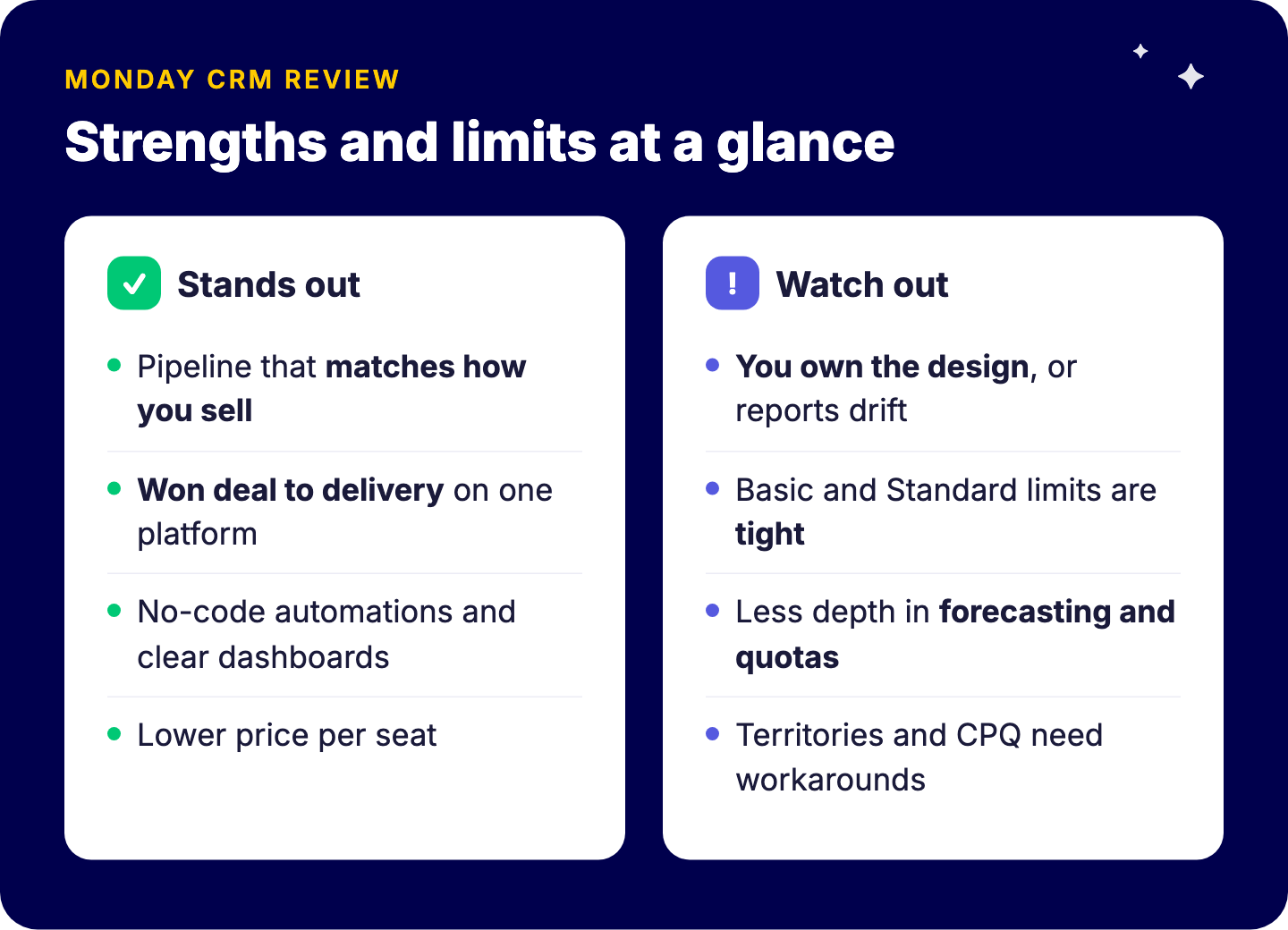
2. Sales-to-delivery handoff. When a deal is won, an automation can create the project, onboarding or order on a delivery board with the right data attached. This is where monday CRM beats standalone CRMs for service companies, agencies and project businesses. We cover the organizational side in aligning sales, projects and operations.
3. Email and activity tracking. The Emails & Activities feature connects Gmail and Outlook so conversations attach to contacts and deals, with email open tracking on Pro and higher.
4. Automations without code. Lead assignment, stage-based reminders and follow-up tasks are quick to set up and easy to change.
5. Visual dashboards. Pipeline value, stage conversion and rep activity are easy to build and understand.
6. Price per seat. List prices are typically below the enterprise CRMs. See our monday CRM pricing breakdown.
An honest review needs this section to be as specific as the one above.
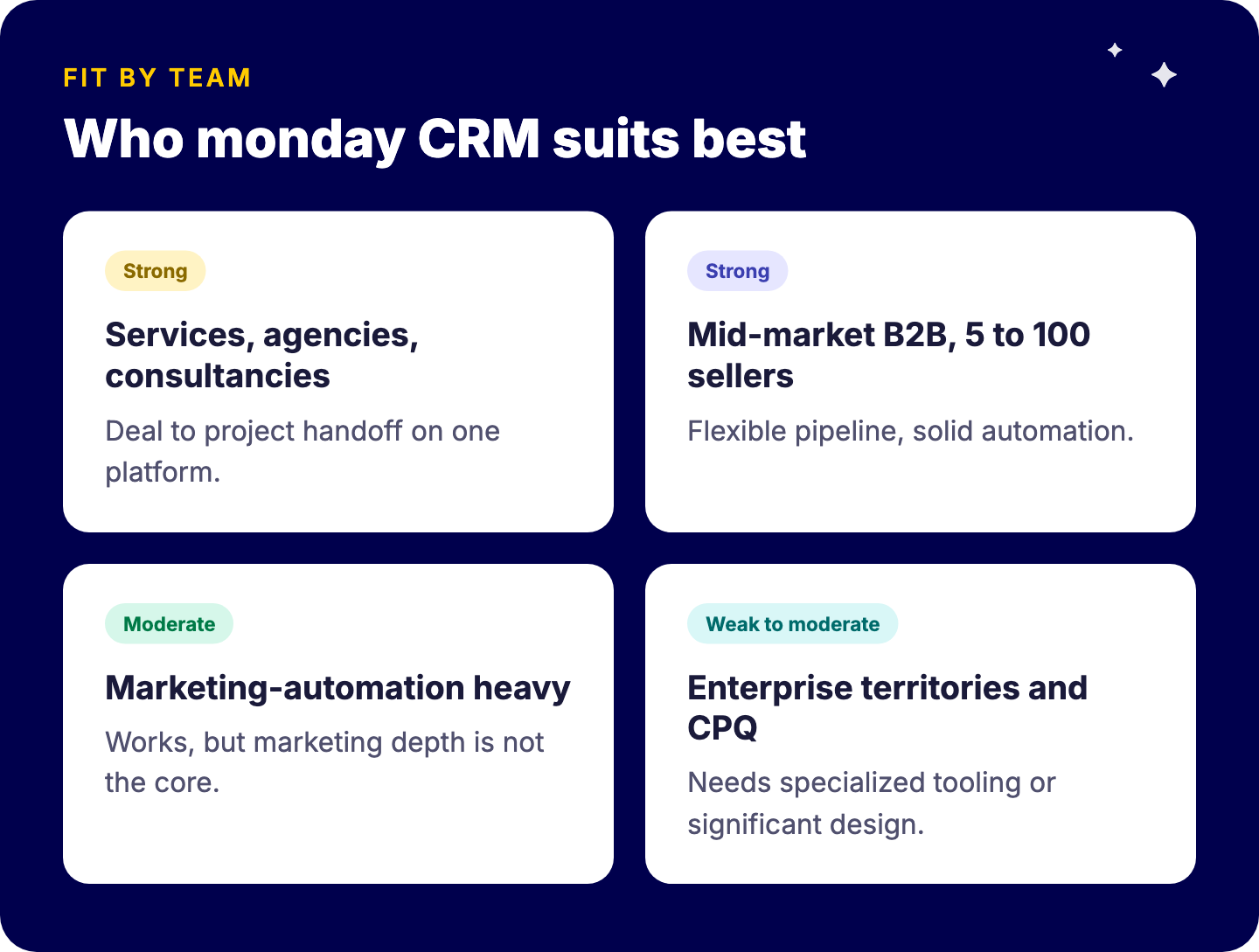
| Team profile | Fit | Why |
|---|---|---|
| B2B services, agencies, consultancies | Strong | Deal to project handoff on one platform |
| Mid-market B2B with 5 to 100 sellers | Strong | Flexible pipeline, solid automation, lower seat price |
| Companies already using monday work management | Strong | One platform, shared data, one vendor |
| Inbound-led teams with heavy marketing automation | Moderate | Works, but marketing depth is not the core |
| Enterprise sales with complex territories and CPQ | Weak to moderate | Needs specialized tooling or significant design |
| A two-person team with a simple pipeline | Moderate | Works, but check whether the platform’s power is needed |
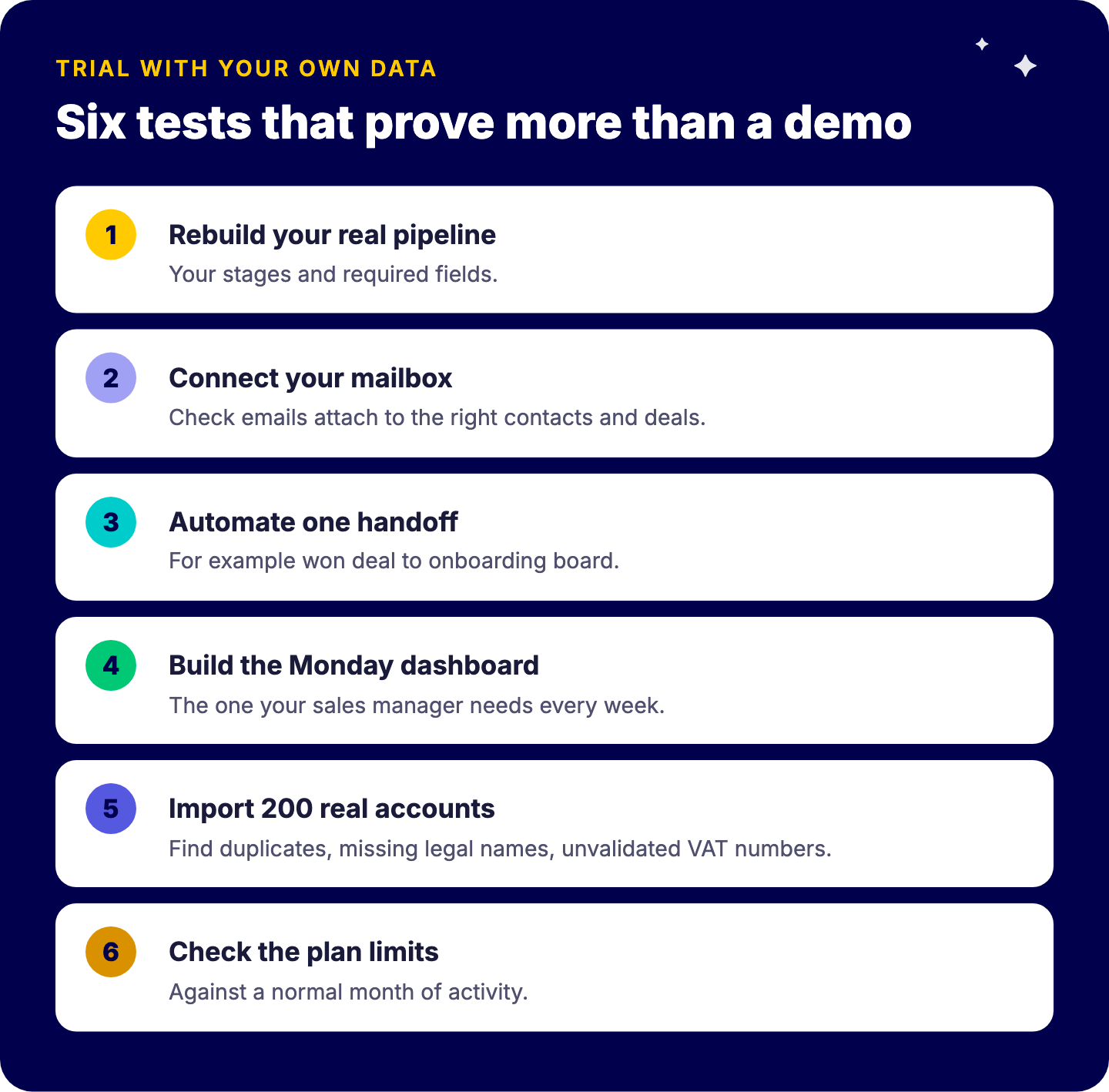
A trial with sample data proves little. Test with your own process:
Then follow our monday CRM implementation guide for the structure that scales.
The results come from process design, not the logo. The Trademart case reports 900 hours saved per year on monday.com. The principle behind numbers like that, map how work really flows and then automate the repetitive steps, applies to a sales pipeline as much as to marketing.
monday CRM is one of the best options for B2B teams that want a CRM shaped around their own sales process and connected to the work that happens after the deal. It rewards thoughtful design and punishes improvisation. If you choose it, invest in the structure up front and pick the plan for the limits you will hit, not the features you might use.
Yes for most small and mid-market B2B teams, especially with a sales to delivery handoff.
Design responsibility, tight lower-plan limits, and less depth in advanced forecasting, territories and CPQ.
Yes, through Emails & Activities, which is available on Standard and higher; email open tracking needs Pro or higher at the time of writing.
Better for flexibility and one platform at a lower seat price; HubSpot for marketing-led teams, Salesforce for deep enterprise customization.
We will map your sales process against monday CRM in a short session and tell you honestly if it fits. Book a free intro call with Tryve.